Amazon 2Q26: after Google and Microsoft, another Cloud acceleration – growth higher – margins higher.

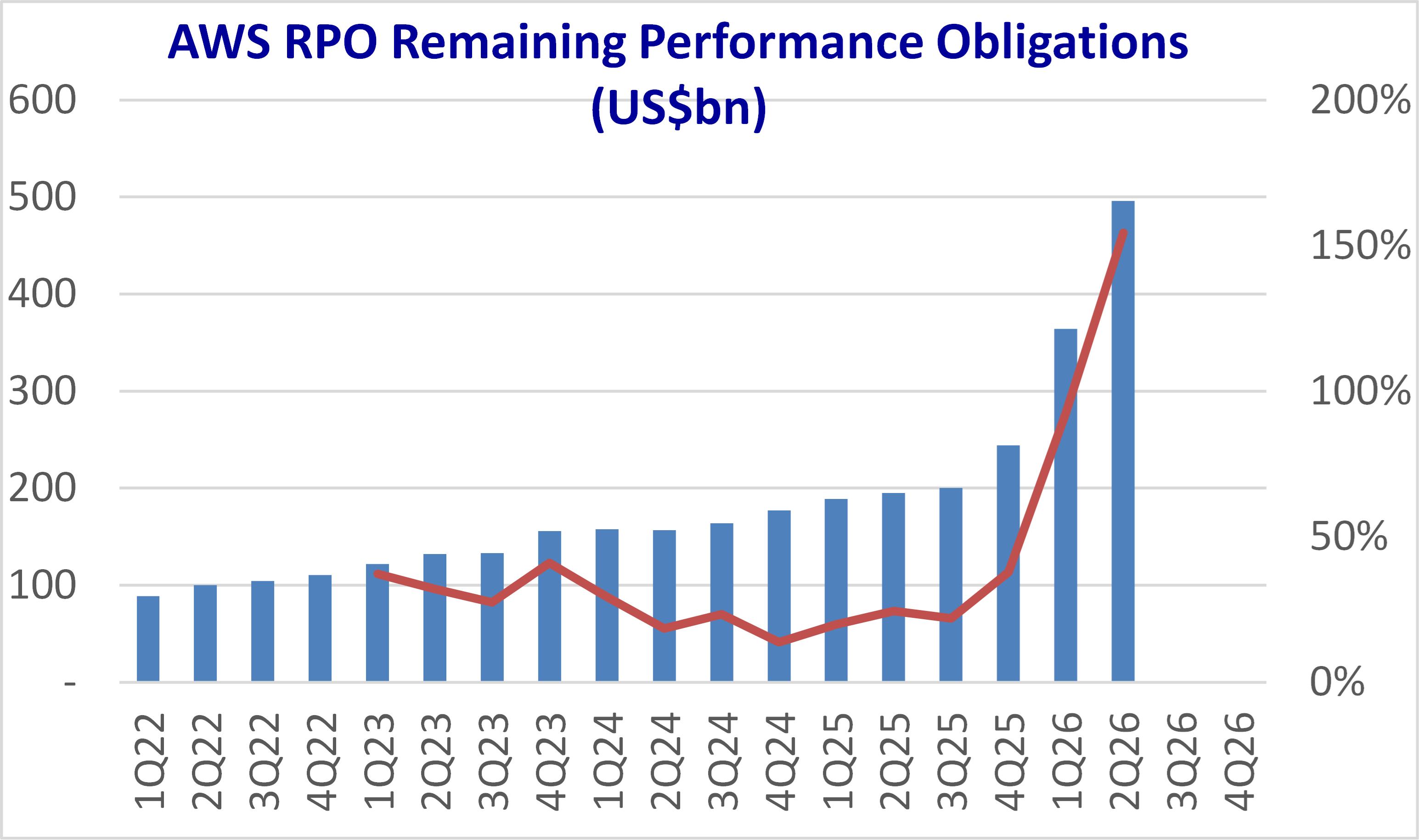
Like for Microsoft, this is probably the quarter that demonstrates the impact of AI Capex on AWS growth and margins. 2Q26 revenue up 20% YoY. Operating profits up 43% YoY. The revenue backlog is literally exploding, up 150% YoY.
AWS Annualized Run rate is at $169bn. CEO suggests that AWS could become a $ 1 trillion business.
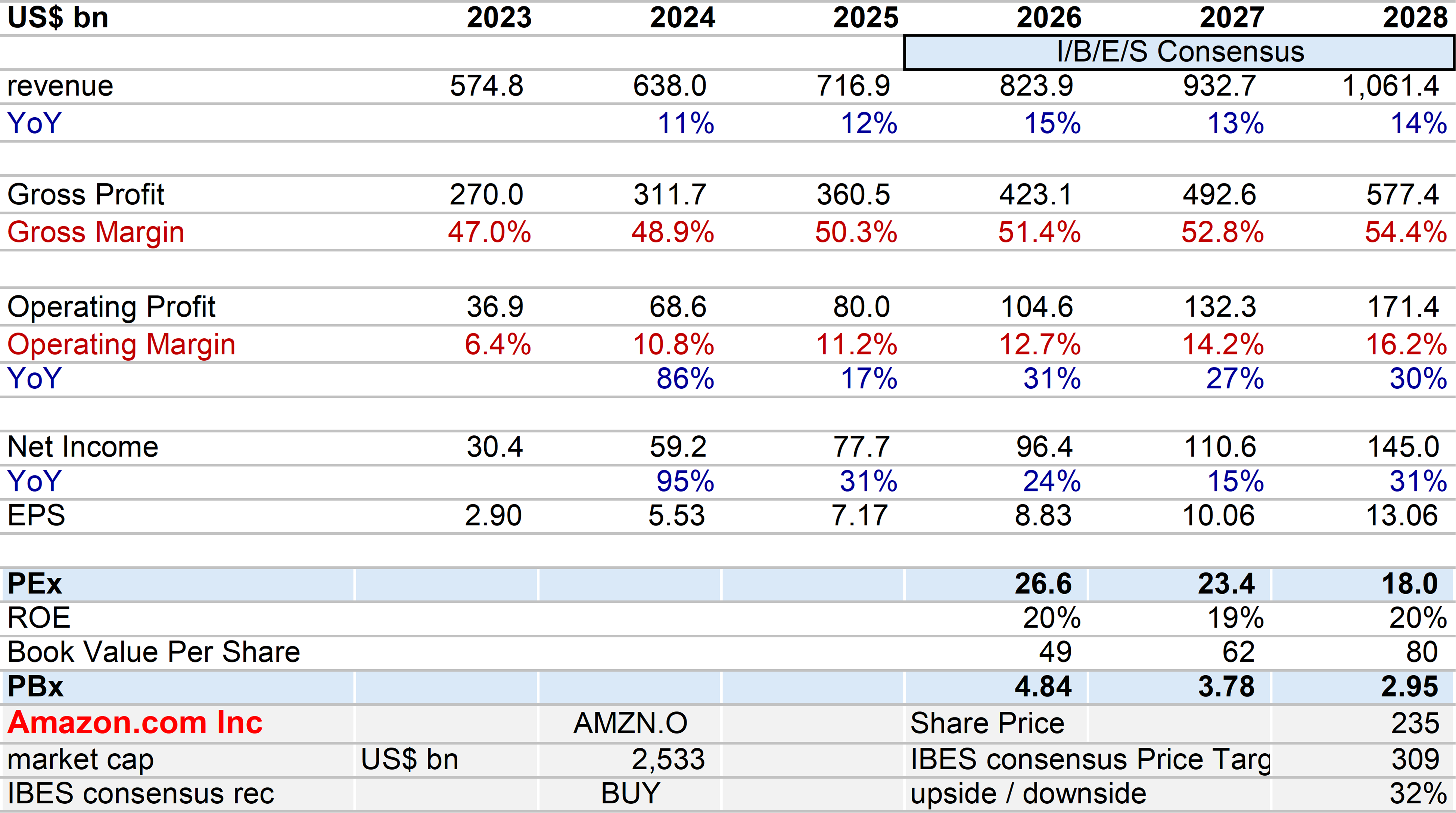
Consensus could be a bit low on revenue growth, high-teens looks more likely than low-teens. Margins expansion is ok. Stock trading at 23.4x 2027 EPS, 18x 2028.
I’ll just show a few charts – followed by a long quote of CEO Jassy. If you have doubts about AI ROI, if you still think that we don’t know yet, that there’s no proof to this pudding, you have to read Jassy’s explanation.
So, I won’t repeat one more time that Cloud growth is accelerating, RPO are booming, margins are expanding…
Google Cloud revenue up 82% YoY. Annual Run Rate $100bn. Operating Margin 36%.
Microsoft Azure revenue up 43% YoY. Annual Run Rate $120bn.
AWS revenue up 37% YoY. Annual Run Rate $160bn. Operating Margin 39%.
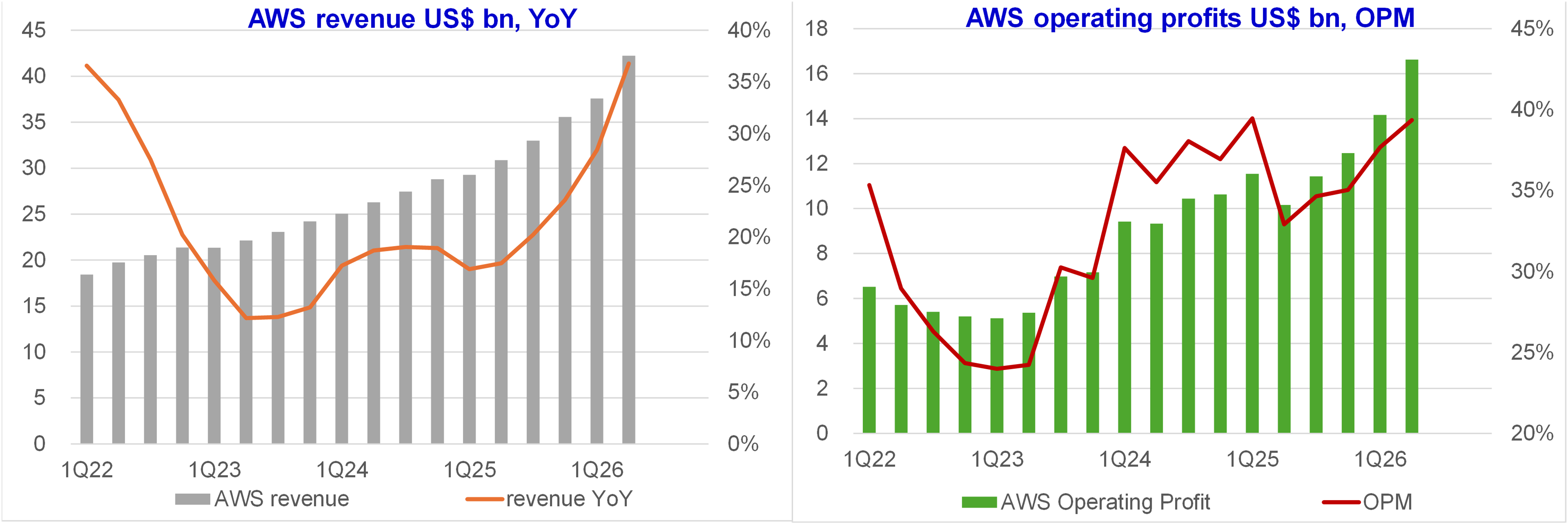
“AWS is booming, growing 36.7% year-over-year in Q2—our fastest growth in 18 quarters
AWS AI business exceeded $25 billion annual revenue run rate for, growing triple-digit percentages year-over-year.
chips business exceeded a $25 billion annual revenue run rate for its, growing triple-digit percentages year-over-year. Continued gaining momentum with Trainium, with the two leading AI labs in the world, Anthropic and OpenAI, making multi-year, multi-gigawatt commitments”
“our backlog stands at $496 billion, growing triple digits year-over-year”
CEO Jassy:
“We’re reporting $200.6 billion in revenue, up 20% year-over-year.
Operating income was $27.5 billion, up 43% year-over-year.
AWS is booming right now, I’ll share why we’re enthusiastic about the ROIC equation, even with heavy CapEx the next few years
we plan to invest approximately $200 billion in cash CapEx in 2026, the majority of which to support AI and AWS. we have clear line of sight to strong financial returns. I’ll explain why. There are 2 major parts of the investment, the data centers and the servers and networking equipment that go into them.
These are different capital cycles.
Data center capital is spent starting 2 years before we can put servers into them to start monetizing. Once a data center opens with servers plugged in, we start generating significant revenue right away and then get to monetize these data centers for 30-plus years without having to spend that start-up capital again.
Servers and networking equipment operate on a shorter cycle. We typically purchase these a few months before putting them into service, so we have strong visibility into customer demand before we trigger the spend. If the demand isn’t there, we won’t spend the capital. For servers and networking equipment, on average, it takes a little less than 3 years to break even on that investment. The servers currently have a useful life of at least 5 to 6 years.
And most of our AI capacity these days is being contracted for at least 5-year terms. That means that we’re driving significant free cash flow on the servers and networking equipment in the 2 to 3 years after we break even. It’s also worth noting that AWS has a strong track record of finding ways to extend the useful life of this equipment without sacrificing customer experience.
So for our data centers, which have 30-plus year useful lives, we should get at least 5 to 6 generations of server economics, with subsequent generations after the first having even better overall economics because we don’t have to repeat that upfront data center investment.
This means in the short term, when demand is necessitating so many data centers being built simultaneously in advance of when we can start monetizing them. We’ll spend a lot of CapEx and encounter free cash flow headwinds and until these data centers come online can be monetized and we get a few years into these servers being utilized. But as we get a few years out, the revenue growth outpaces the incremental CapEx growth, which will happen at some point. The resulting revenue, free cash flow and return on invested capital is very compelling.
We’ve done this before in the first era of cloud computing.
We now believe we will spend approximately $220 billion in cash CapEx in 2026. The higher cost of memory pushing this number up from a prior estimate of about $200 billion. But even at that amount, we will still not have enough capacity to meet all the demand we have in 2026. And I believe this dynamic will also be true in 2027 too.
In fact, the demand we already have for 2028 is striking. And remember, enterprises are still very early in using inference at scale in their current production applications.
AWS could become very positively be $1 trillion annual revenue business for us in time with very appealing accompanying free cash flow and return on invested capital.”
AI growth is driving non-AI
“We’re seeing strong growth across both AI and non-AI, what we call core-growth in one is driving growth in the other. Growth in AI drives non-AI because post training reinforcement learning and agent tool use is mostly done on CPUs versus AI accelerators
We see a strong linkage between AI spend and core growth (this means demand for non-AI CPU computing cores). As customers invest in AI, we see a core spending increase in core consumption. We expect this relationship to strengthen over time as more AI workloads move into full-scale production and drive additional demand for our core services”
“technically competent companies are going to build their own foundation models, not the really big frontier models, but smaller models that leverage their proprietary data
companies will construct their own purpose-built agents from the ground up, most will also use turnkey agentic services”
2Q26 above Consensus by a mile
Operating Profit 17% above expectations. Strong margins expansion.

3Q26 guidance just inline
Unless we have another margins beat?

Consensus, Valuations
Consensus could be a bit low on revenue growth, high-teens looks more likely than low-teens. Margins expansion is ok.
Stock trading at 23.4x 2027 EPS, 18x 2028.